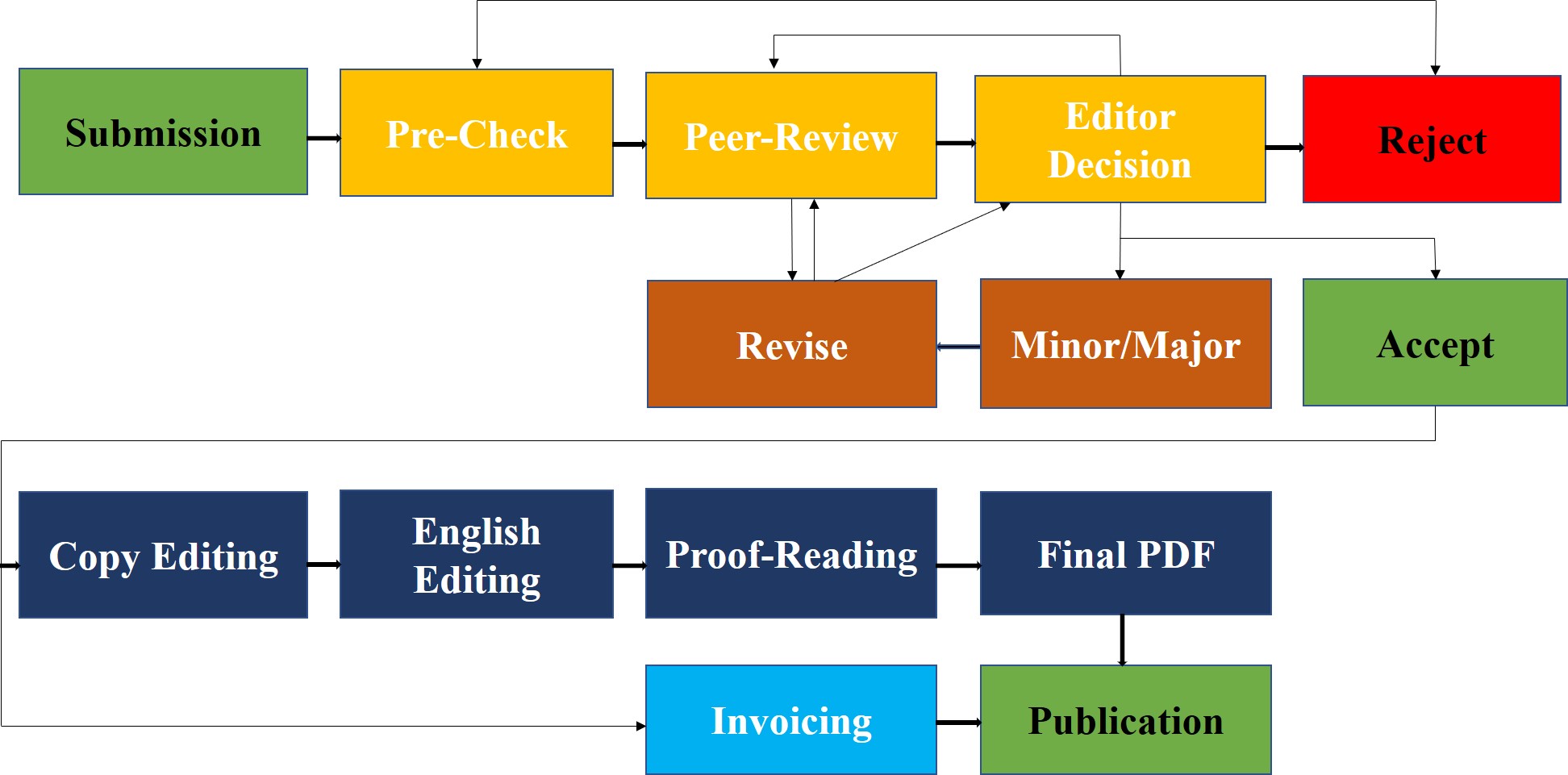
Double Blind Peer Review & Editorial Process
Pakistan Biomedical Journal operates a double-blind peer review process: the identities of authors and reviewers are not disclosed to each other. Each manuscript that passes initial editorial screening is sent to at least two external reviewers with expertise in the relevant field, who are not affiliated with the the journal’s editorial office. If the reviewers’ recommendations conflict, the editor may seek a third review. The final decision to accept or reject rests with the Editor-in-Chief.
A decision is usually reached within 60–90 days of submission. Authors of accepted manuscripts are informed of the volume and issue in which their article is scheduled for publication. Publication may be scheduled for a later issue because Higher education commission journals and publications policy-2024, As Amended w.e.f November 5th, 2025)Version 2.0, limits regular issues to a maximum of 30 articles.
If an editor has a conflict of interest with a manuscript, that editor plays no part in its handling, and another member of the Editorial Board oversees the peer review and decision. Reviewers’ identities are kept confidential, and the pre-publication review history of articles is not published. Providing false information, such as a false name or email address for an author or suggested reviewer, will result in rejection and may lead to further action under the journal’s misconduct policy.
Editorials are written or commissioned by the Editor-in-Chief. Guest editorials submitted by authors are first reviewed internally by the Editor-in-Chief or an Editor, and then sent to an external expert, such as an invited guest editor in the field, for review. The final decision on all editorials, as on all other content, rests with the Editor-in-Chief.
Use of Generative AI and AI-Assisted Technologies in the Peer Review Process
a. Journal upholds the highest standards of integrity and confidentiality in the peer review process. Manuscripts sent for review are strictly confidential documents and must not be shared, uploaded, or processed using generative AI or AI-assisted tools. Doing so may compromise the confidentiality and proprietary rights of authors, and, in cases involving personal data, may also breach data privacy regulations.
b. This confidentiality requirement also applies to peer review reports, which may include sensitive or identifiable information. Reviewers should therefore not use AI tools—even for tasks such as improving language or readability—when preparing their review reports.
c. Peer review is a human-driven process that requires independent judgment, critical evaluation, and subject expertise. Generative AI or AI-assisted technologies must not be used to perform or assist in the scientific evaluation of manuscripts. Such technologies lack the nuanced reasoning and accountability expected of human reviewers and may introduce errors, bias, or incomplete analysis.